Affichage des articles dont le libellé est Art. Afficher tous les articles

mardi 25 octobre 2011

Chrysalis- film chorégraphie

À voir aussi le site de Wayne McGregor, son travail sur le rapport au corps est vraiment hors pair (dont Dyad 1929).

«Chrysalis, chorégraphié et interprété par Wayne McGregor et ses danseurs aléatoire est un barrage d'effets spéciaux, le résultat est une mêlée inquiétante du futurisme à un score du même genre que les films d'horreur. McGregor joue le rôle d'un insecte demi, moitié humain de métal-tête plaquée, rampant autour dans un bain, filaire à des dispositifs technologiques futuristes qui semblent nous donner un aperçu de son processus de pensée. Nous sommes pris dans le luminarium de son esprit, où pauvrement vêtu chiffres de danse au milieu des bâches en plastique sale à une cacophonie de sons -. Couinements, drum and base et de sons électroniques, entrecoupées de schémas anatomiques du cerveau humain ».


mercredi 19 octobre 2011

NANOTOPIA / Michael Burton


Utopia for who?

Nanotechnology promises a utopian vision as a result of our future capability of manipulating the world around us on a nanoscale. As presented by Professor Richard Jones, author of Soft Machines: nanotechnology and life, the true potential of this new technology is when it is fused with organic living systems, like viruses, cellular automata and self-replication.

If our production methods shift to simulate organic self-replication what will happen to the global socio-economic balance? How will the gap between rich and poor be affected? How will people dependent on income from manual production survive?

With these questions as a premise, nanotopia presents a future vision for people at the extremities of the social classes. The project references how people currently use their bodies as a last resort, to sell their hair, blood and kidneys. Nanotopia then envisions a future where the poorest utilise new possibilities of fusing nanotechnology and the body as real-estate. In reaction to this use of the body, the film also visualises the changes in bodily aesthetics within the upper classes.


Source: http://www.michael-burton.co.uk/index2.htm

lundi 10 octobre 2011

Hussein Chalayan

"One Hundred and Eleven" Printemps-été 2007


Hussein Chalayan s'est inspiré de la façon dont les événements du monde, y compris les guerres, les révolutions, les changements politiques et sociaux, ont façonné la mode durant un siècle.
Avec One Hundred and Eleven, Chalayan explore le concept du "morphing" et crée une série de robes mécaniques qui se métamorphosent d'un style, d'une époque à l'autre. La bande-son contraste avec la formidable prouesse technologique en rassemblant des fragments audio provenant de réacteurs de jet, d'une guerre des tranchées et de bombardements aériens.

vendredi 19 août 2011

Strandbeesten (Theo Jansen)


Theo Jansen est un artiste sculpteur néerlandais du courant de l'art cinétique, qui se base sur l'art du mouvement que ce soit à travers des œuvres mobiles ou des illusions d'optiques.
Ses œuvres sont notamment caractérisées par des sortes d’insectes géants réalisés avec des tubes en plastique, se mouvant grâce à la force du vent
La particularité de son travail est de s'inspirer de la théorie de l'évolution génétique (sélection + reproduction (avec variantes aléatoires) du plus performant) pour guider l'évolution du design de ses sculptures mobiles quasi-autonomes (qu'il nomme "créatures"). La finalité de son travail de recherche semble plus orienté vers des finalités pratiques qu'esthétiques, on peut donc aussi le classer dans la catégorie des ingénieurs/inventeurs.


Sources Strandbeest + Wikipedia

Small work for robot and insects (Andie Gracie)


'Small work for robot and insects' has evolved over a period of three years. v1 was a commission from digitalsummer01: inter[face] to produce a small sound based piece of work, and formed part of a series of investigations into interfaces between natural and technological systems. The work consisted of a group of crickets and a simple quadruped robot existing in a large glass tank, seperated by a glass divider. The sound of the cricket song was transmitted to the robot which made a series of random movements in response.

v2 was commissioned by Arnolfini Live and is a much more sophisticated work. A new hexapod robot was designed and built from scratch and a neural network brain was programmed by Brian Lee Yung Rowe of Muxspace, New York. The robot is now able to listen intelligently to the cricket song and attempt to devise a unique language with which to communicate with them or provoke them into certain behaviours.

The work frames an interest in exploring connections between machine and nature that are outside the typical areas covered by cybernetics or purely scientific study. It illustrates the attempts to allow spontaneous relationships to emerge and provide a platform for us to witness the process. By forming a mechanical entity with qualities which are vaguely lifelike but which have the capacity to behave in a completely non-lifelike manner we allow the formation of spontaneous relationships that inhabit a ‘third state’. All parts of the system need to adapt to each other for meaningful communication and exchange to take place, rather than informed response. Once, and if, this third state is achieved the entities can begin a mutual exchange of information which will continually evolve and develop nuance.

The robotic element of the installation is a custom designed and built polycarbonate and aluminium hexapod with the capacity to express itself using movement, lights and sound. It has an initial library of 18 base motions, 7 base light sequences and 32 base sounds which can be considered as 'phonemes', a starting point from which can be extracted any sequence or combination to construct a complex and evolving vocabulary.

The incoming sound from the crickets is analysed using fft processes in max/msp and the resulting numerical data is passed to the neural network. Once the neural network has done its processing it passes back the numerical representation of the ‘sentence’ to max/msp which relays it via serial to the robot. The robot carries an onboard microprocessor (OOPic) loaded with a programme to control its functions, which are triggered by the data coming from the neural network.

Farm Fountain (Ken Rinaldo & Amy Youngs)


Farm Fountain is a system for growing edible and ornamental fish and plants in a constructed, indoor ecosystem. Based on the concept of aquaponics, this hanging garden fountain uses a simple pond pump, along with gravity to flow the nutrients from fish waste through the plant roots. The plants and bacteria in the system serve to cleanse and purify the water for the fish.

This project is an experiment in local, sustainable agriculture and recycling. It utilizes 2-liter plastic soda bottles as planters and continuously recycles the water in the system to create a symbiotic relationship between edible plants, fish and humans. The work creates an indoor healthy environment that also provides oxygen and light to the humans working and moving through the space. The sound of water trickling through the plant containers creates a peaceful, relaxing waterfall. The Koi and Tilapia fish that are part of this project also provide a focus for relaxed viewing.

The plants we are currently growing include lettuces, cilantro, mint, basil, tomatoes, chives, parsley, mizuna, watercress and tatsoi. The Tilapia fish in this work are also edible and are a variety that have been farmed for thousands of years in the Nile delta.


Joyful Trees (Diller & Scofidio + Renfro)


Arbores Laetae – or Joyful Trees – has transformed a former brownfield site as part of the 2008 Liverpool Biennial arts festival.

Designed by New York architects Diller, Scofidio and Renfro, festival bosses say the work gives people a chance to “view nature at its most unnatural”.

The slowly rotating trees, intended to be a playful reinvention of the public park, were largely welcomed by members of the public in their unveiling.

The three rotating trees can found at the heart of 17 hornbeam trees planted in a grid pattern at the corner of Great George Street and Parliament Street, but are not immediately obvious to passing pedestrians or traffic. In place of the familiar movement of shade according to the rotation of the earth around the sun, here shade migrates at an artificial speed, transforming the familiar patterns of the natural world into artificial creations.

Some people find their unfamiliar shading patterns tranquil and others, unsettling, which was the aim, according to designer, Rick Scofidio.

Mr Scofidio told BBC News: “I found that it’s both beautiful, wonderful and a little bit frightening.

“Trees in poems are beautiful objects, but they are also things that tap on your window at night and in many fairy stories are quite evil and dangerous.


Carnivorous Domestic Entertainment Robots (Auger-Loizeau & Alex Zivanovic)

Over the coming years, Robots are destined to play a significant part in our daily existence. The idea of sharing our lives with these artificial entities in their various guises has captured the public imagination for decades.

Robots have represented both our hopes and fears for what the technological future may hold, yet at this time they remain very much an enigma. There is a huge disparity between the profound potential robots exhibit in the realms of science fiction and our imagination; the banal reality of vacuum cleaners, lawnmowers and robotic pet dogs; and the vision of robots as seen through the eyes of computer scientists and engineers.

With this project we propose an alternative perspective on domestic robots, exploring both the aesthetics and functionality that may elicit a symbiotic co-existence with humans in their homes.

To achieve acceptance the robots operate on different levels :

Inspired by natural methods of adaptation, they have shunned the stereotypical look normally associated with robots and adopted a fashionable, contemporary design aesthetic. In this way they operate as exclusive furniture and household accessories.
Utilising the microbial fuel cell as an energy source the robots reference strategies of predatorial insects, reptiles and plants such as the wolf spider, the chameleon and the Venus flytrap and apply these harvesting techniques to the acquisition of food. This gives them autonomy and to a degree they become living entities existing in a similar way to an exotic pet such as a snake or a lizard, where we provide living prey and become voyeurs in a synthesized, contrived microcosm.
We might sit around the objects waiting for the spectacular moment when the prey is captured and slowly transformed into moving energy bars on the graphic displays built into some of the objects.

In this way they provide a dark form of entertainment competing with the spectacle of life seen in television programs such as Big Brother, Wife Swap or edited and dramatised depictions of war. As consumers of these programs, like those who keep vivariums, we have the potential to be repulsed, engaged or both.

They are currently built as a series of five semi-operational prototypes :

Lampshade robot

Flies and moths are naturally attracted to light. This lamp shade has holes based on the form of the pitcher plant enabling access for the insects but no escape. Eventually they expire and fall into the microbial fuel cell underneath. This generates the electricity to power a series of LEDs located at the bottom of the shade. These are activated when the house lights are turned off.


Mousetrap coffe table robot

A mechanised iris is built into the top of a coffee table. This is attached to a infra red motion sensor. Crumbs and food debris left on the table attract mice who gain access to the table top via a hole built into one over size leg. Their motion activates the iris and the mouse falls into the microbial fuel cell housed under the table. This generates the energy to power the iris motor and sensor.


Fly stealing robot

This robot encourages spiders to build their webs within it's armature. Flies that become trapped in the web are tracked by a camera. The robotic arm then moves over the dead fly, picks it up and drops it into the microbial fuel cell. This generates electricity to partially power the camera and robotic arm. This robot also relies on the UV fly killer parasite robot to supplement it's energy needs.


UV fly killer parasite

A microbial fuel cell is housed underneath an ultra violet fly killer. As the flies expire they fall into the fuel cell generating electricity that is stored in the capacitor bank. This energy is available for the fly stealing robot.


Fly-paper robotic clock

This robot uses flypaper on a roller mechanism to entrap insects. As the flypaper passes over a blade, captured insects are scraped into a microbial fuel cell. Electricity is generated to turn the rollers and power a small LCD clock.
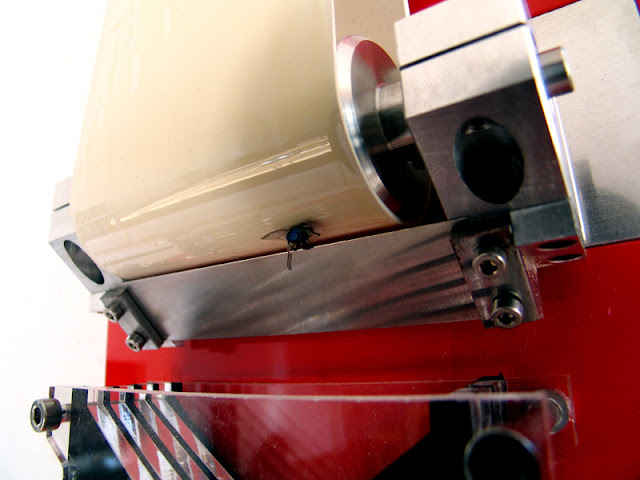


Carnivorous Domestic Entertainment Robots were designed by James Auger, Jimmy Loizeau and Aleksandar Zivanovic. Julian Vincent is director at the Centre for Biomimetics and Natural Technologies, and acted as an advisor to the design process. An initial start point for the project was Ecobot, a fly-eating robot developed at Bristol Robotics Laboratory which uses microbial fuel cells to generate its own power.

Microbial fuel cell kits are available from the National Centre for Biotechnology Education (NCBE) at Reading University.

Source Material Beliefs

Autoinducer_Ph-1 (Andie Gracie)


Autoinducer_Ph-1 is a semi-synthetic ecosystem that explores the question of how the evolutionary adaptation of natural organisms to artificially-created living entities might happen, and vice versa. It consists of biological, electro-robotic and computing processes, thus staging a permanent interaction between an artificial bacteria, a techno-organism based on software and a robotic system, and three organic protagonists: rice, Azolla fern, and the cyanobacteria Anabaena. The installation takes traditional rice cultivation techniques from Asia, where the water fern Azolla is used as an organic, nitrogen rich fertilizer in rice paddies, as its starting point. Andy Gracie turns them into a complex networked laboratory mirroring contemporary agricultural techniques and the increasingly machinic nature of ecosystems.

Autoinducer_Ph-1 probes into and interferes with the symbiosis between the water fern Azolla and the cyanobacteria Anabaena, which helps grow the oval Oryza sativa rice field in the gallery. An information system with gas sensors captures data about the relationships between the organic protagonists of the installation, and sends them to an artificial, software-based bacteria that then interacts with them either symbiotically or parasitically. Through this interface, the synthetic bacteria is fully integrated into the ecosystem and exerts an equal influence on the system’s equilibrium as the real organisms. If the core of the system “understands” the relationship as symbiotic, it will instruct its robotic arms to begin to scoop out Azolla and deliver it to the rice. If the relationship is interpreted as being more parasitic, the arms will withhold the delivery. The robotic arms are also capable of evolving new expressive movements, based on the ecological data they receive – ballet-like movements which express the state of the system as a whole. Artist Andy Gracie expects that, if maintained for several generations, the natural proponents of this semi-synthetic ecosystem will evolutionarily adapt to the artificial bacteria.


Andy Gracie works across various disciplines including installation art, robotics, sound, video and biological practice. His works create situations of exchange between natural and artificial systems which allow new emergent behaviours to develop.


Source Biofaction

La part animale (Art Orienté Objet)

La part animale, c’est le titre de l’exposition qui a été présentée au Centre d’Art Contemporain Rurart, à Vouillé, près de Poitiers, en mai 2011. Une exposition dans le prolongement de la performance Que le cheval vive en moi, réalisée le 22 février dernier à Ljubljana en Slovénie par le duo Art Orienté Objet. Ce jour-là, Marion Laval-Jeantet se faisait injecter par son partenaire Benoît Mangin du sang de cheval. Entrer en communication avec l’étrangeté animale, au-delà d’une vision anthropocentrique du monde, tel était l’enjeu de cette exploration contemporaine de la relation homme-animal, aux frontières de la science et de l’art.


« Être ange, C’est étrange Dit l’ange. Être âne c’est étrâne dit l’âne »…
 (Jacques Prévert, dans Fatras)
On aurait envie d’ajouter : « Être cheval, c’est quoi ? ». Car c’est bien là le point de départ du questionnement et du terrain d’expérimentation scientifico-existentialo-artistique du couple Art Orienté Objet. « En fait, c’est quelque chose qui vient à l’origine d’une conviction très ancienne, commune à Benoît et à moi, selon laquelle le sens de notre existence terrestre, c’est la dissemblance, le fait qu’on soit tous séparés les uns des autres et que, du coup, on ait à s’adapter à cette notion d’altérité. On est donc complètement obsédé par la question de l’altérité », explique Marion Laval Jeantet. Cette question, ils l’ont bien sûr travaillée avec l’homme (minorités sociale, culturelle, ethnographique, etc), puis, « forcément », avec l’animal, « en tant qu’autre à la fois très accessible, au sens où il est très individué et très communicant, mais en même temps très différent ».

Le choix s’est porté davantage sur les mammifères avec lesquels il est plus facile d’établir une « correspondance ». Des prothèses exposées à Rurart jalonnent ce parcours, des félins au cheval, en passant par les cervidés. En ce qui concerne l’expérimentation du « sang étranger », le choix initial du panda a dû être abandonné, trop compliqué à mettre en œuvre, notamment pour des raisons éthiques. Le choix s’est finalement porté sur le cheval qui, étant donné sa constitution et son  comportement éloignés de ceux des primates, était  susceptible de provoquer davantage d’effets dans le cadre de l’expérience. Et puis, en arrière plan, n’y a-t-il pas l’hybridation mythique du centaure …

Sur le plan scientifique, l’expérience aura été préparée minutieusement pendant plus de trois ans, avec un travail auprès de chercheurs et de laboratoires sur les  questions de ‘compatibilisation’ du sang, afin de prendre le moins de risques possibles lors de l’injection. « En fait il y a eu tout un processus de mithridatisation, c’est-à-dire qu’on m’a progressivement habituée à différentes familles d’immunoglobulines, pour qu’il n’y ait pas un rejet massif du corps lors de l’injection. Au tout début, j’y allais un peu inconsciemment, puis à un moment j’ai commencé à ressentir des effets, à avoir des troubles du sommeil. Je me suis alors dit que ce n’était pas anodin ».


Parallèlement, sur le plan formel, la réalisation de prothèses permettait d’établir une autre sorte d’approximation, d’appropriation de l’être-cheval, en se mettant à sa hauteur, au sens littéral : « la première fois que j’ai mis ces prothèses, le haut de mon crâne était à la hauteur de celui du cheval. Donc, on avait les yeux au même niveau. C’est toujours un peu ce fantasme des primates humains que nous sommes de pouvoir fixer son regard dans la même configuration, la même attitude que l’autre, que l’animal ».


Tous ces éléments auront été réunis et hautement ritualisés le jour de la performance, réalisée le 22 février 2011 en public, à la Galerie Kapelica, à Ljubljana, en Slovénie. Comme on peut le voir dans le film réalisé à cette occasion, temps fort de l’exposition La part animale à Rurart et que Marion Laval-Jeantet résume :
 « Benoît m’injecte le sérum du sang de cheval, ensuite je reste un peu allongée pour être sûre qu’il n’y a pas de choc anaphylactique. Pendant ce temps-là un film est projeté à l’intention du public qui assiste à la performance. Ensuite j’enfile cette paire de prothèses pour faire plusieurs tours de la salle avec le cheval, puis je vais m’allonger à nouveau. En fait le timing est organisé pour que vingt minutes plus tard on prenne mon sang au moment où les marqueurs des antigènes du corps humain qui témoignent de la présence d’un corps étranger équin en moi sont les plus présents. Ce sang va être ensuite lyophilisé devant le public pour en faire une sorte de fétiche que vous retrouvez dans ces boites métalliques qui sont un peu comme des reliquaires, dans lesquels vous avez donc – aussi étrange que cela puisse paraître – du sang de ‘centaure’, c’est-à-dire le sang au moment du croisement entre les deux, mais lyophilisé, donc sous forme de poudre ».

La collection de ces huit reliquaires, de beaux objets sur lesquels sont gravés les symboles traduisant chaque étape des réactions du système immunitaire, mêle de manière inattendue les dimensions scientifiques et mystiques de l’expérience.

Ces deux dimensions sont également présentes dans la description que fait l’artiste des effets ressentis après l’injection. Si certains – comme les troubles du sommeil – avaient déjà été éprouvés lors des injections préliminaires,  « disons que l’effet inattendu c’est celui de la jonction de tous ces effets ensemble, qui fait qu’on ressent une hyperactivité, possiblement thyroïdienne, souligne Marion Laval-Jeantet. On est très très nerveux, au sens d’un métabolisme accru, d’une impression de puissance, avec en même temps  une émotivité très supérieure en raison d’une stimulation des glandes surrénales, de l’hypophyse, qui fait qu’on est très inquiet et très émotif. Cette contradiction apparente entre une puissance physique et une fragilité psychologique m’a semblé très intéressante, parce qu’en opposition avec la structure psychologique de l’homme où, en général, on a un sentiment soit de puissance, soit de fragilité, mais rarement les deux en même temps. Ce genre de phénomènes contradictoires, qui sont peut-être inhérents à l’essence chevaline – on ne sait pas – constituent une impression tout à fait étonnante, parce qu’elle est très clairement évocatrice d’une altérité. C’est comme si j’avais momentanément vécu une altérité ».

Quant à prouver scientifiquement que cette « altérité »  est bien chevaline – comme l’artiste en a la « conviction » – que les altérations métaboliques sont « vraiment liées à des vecteurs équins », c’est évidemment difficile, voire impossible. « Si ce n’est que le côté anarchique, inflammatoire, disparaît très vite, et qu’ensuite les conséquences ne sont plus de cet ordre. C’est autre chose, souligne Marion Laval-Jeantet. Ce sont, je dirais, les immunoglobulines qui ont réussi à franchir la barrière immunitaire qui continuent à avoir une action sur le métabolisme humain. Et là, je dirais qu’il y a tout de même des choses qui témoignent d’une autre essence ».

Ce dont témoigne aussi cette expérience, cette performance, c’est d’une tendance de l’art contemporain à se rapprocher des sciences et des biotechnologies, et aussi de la traduction dans l’art d’un nouveau rapport entre l’homme et l’animal, basé sur le rejet de l’anthropocentrisme. « Il y a une signification qui change fondamentalement, explique Jens Hauser, le commissaire de l’exposition. Ce n’est plus l’animal allégorique, mais l’animal partagé corporellement. C’est cela qui est nouveau, parce qu’on retire à l’animal le caractère symbolique octroyé par l’être humain pour se concentrer sur une physiologie partagée ».

Il n’en reste pas moins que tout cela est troublant. Qu’on ne peut que s’interroger, tant sur la finalité et l’enjeu de l’expérience, que sur le caractère artistique de la démarche, en dépit de la volonté affichée de Art Orienté Objet que « que l’art reste un témoin de son époque ».  A l’appui, Marion Laval-Jeantet rappelle que si « Rembrandt en train de peindre la leçon d’anatomie, c’était transgressif, c’était aussi une manière de montrer que ça avait lieu », pour conclure : « On est un peu dans la même logique ».